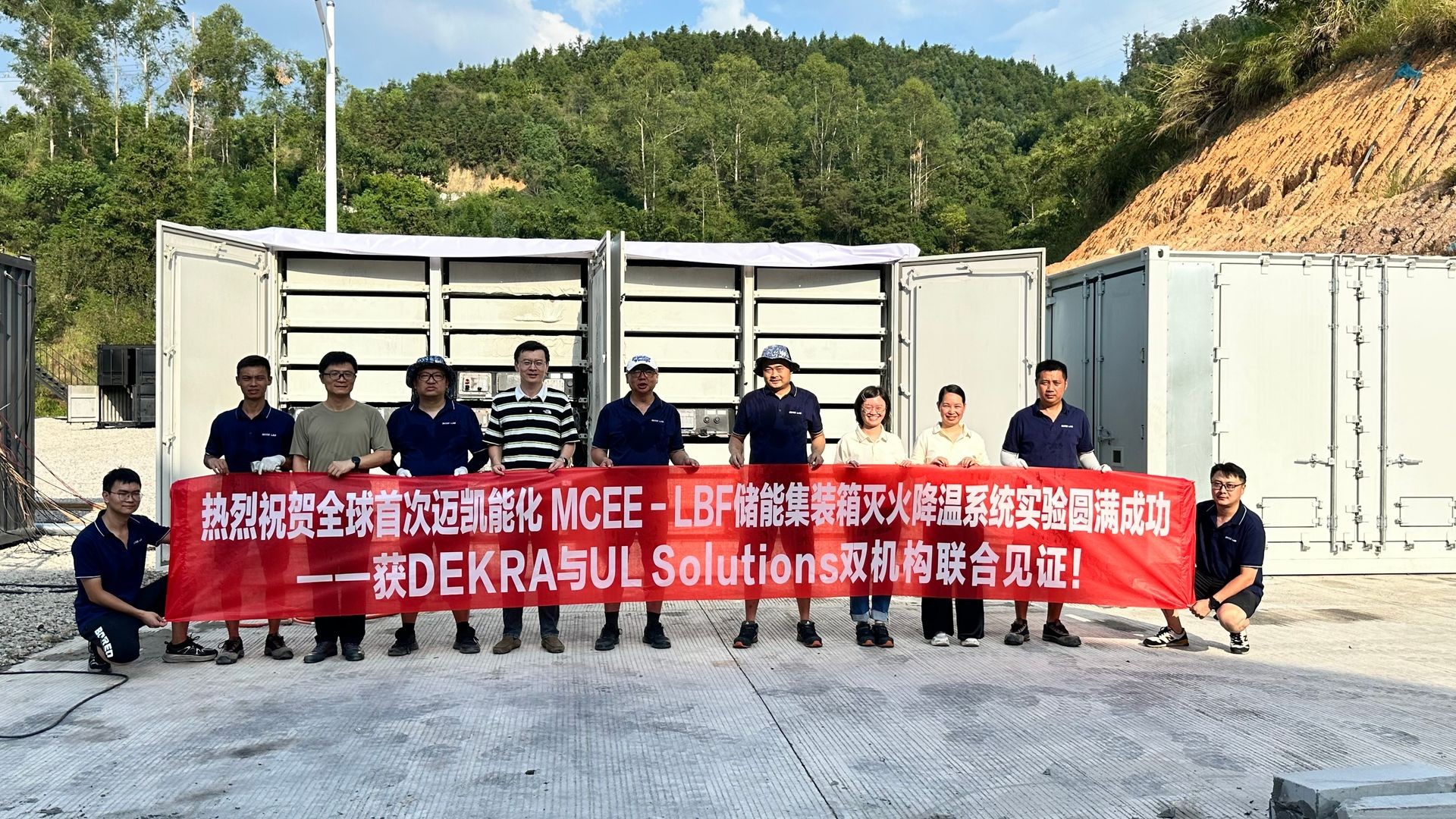
MCEE Solutions completes 5 MWh container-level thermal runaway propagation test, witnessed by DEKRA
SanMing City, Fujian, China — September 2025
MCEE Solutions has completed what it believes to be one of the most rigorous large-scale thermal runaway propagation tests conducted on a containerised lithium-ion battery energy storage system to date — a live fire event at 5 MWh scale using 530Ah LFP cells, independently witnessed by UL Solutions and DEKRA. Formally documented by DEKRA Testing and Certification.
The test took place at the MCEE lab fire testing facility in SanMing City, Fujian Province, and marks a significant milestone in the company's multi-year programme to validate its LBF system at the cell formats and system scales now being deployed in utility-scale energy storage projects globally.
What was tested
The test involved a containerised BESS with a total installed capacity of approximately 5 MWh, using lithium iron phosphate cells rated at 530Ah, among the largest-format cells currently in commercial deployment. Battery cells were supplied by CATL, whose representatives attended the test as observers alongside the DEKRA and UL Solutions witness teams.
Thermal runaway was initiated by deliberately overcharging all 104 cells within a single battery module simultaneously. This initiation method — overcharging an entire module rather than a single cell, was chosen to represent a worst-case scenario, placing maximum thermal and gas generation stress on the surrounding system from the outset.
What happened
The MCEE LBF system activated and contained the thermal runaway event within the initiating module. DEKRA's formal Witness Test Report (Report No. 6234892.50, issued 30 December 2025) confirmed three outcomes:
- No propagation to adjacent modules within the container.
- No open flames observed at any point during the event.
- All non-initiating modules satisfied post-event insulation resistance and withstand-voltage criteria, confirming that the electrical integrity of the surrounding system was preserved throughout the event.
The physical integrity of the BESS container was maintained throughout.
Why this matters
As battery cell capacities increase and containerised BESS installations approach 5 MWh and beyond, the consequences of thermal runaway propagating beyond a single module change qualitatively. The thermal and gas dynamics inside a confined rack structure at this scale behave differently from what small-scale or module-level testing captures — a pattern MCEE's testing programme has documented consistently across cell, module, rack, and container configurations.
The result of a propagation event that reaches container level is not simply a larger fire. It is a different category of event: extended firefighting operations, prolonged business interruption, and asset losses measured in millions rather than thousands.
Stopping the cascade before it begins, at the module level, before propagation reaches the rack, is the specific engineering problem the LBF system is designed to address.
The regulatory context
NFPA 855 (2026), the leading US standard for stationary energy storage systems, now formally defines Thermal Runaway Propagation Protection as a named safety category for the first time, with requirements for documented effectiveness testing. The September 2025 test was designed and conducted at the scale this standard addresses.
The test methods that define precisely how TRPP effectiveness should be measured are still being developed, a process MCEE is actively engaged in alongside DEKRA.
Test documentation
The full DEKRA Witness Test Report (Report No. 6234892.50) is available on request to qualified enquiries including utilities, insurers, project developers, and fire protection engineers.
To request the report, contact: [email protected]